




Claude and Codex: how modern artificial intelligence is changing programming, business, and the digital world.

 May 18, 2026
The world of technology is changing faster than ever before. What seemed like science fiction just a few years ago is now actively used in business, programming, marketing, education, and daily life. Artificial intelligence has become one of the main drivers of these changes.
Modern AI systems are capable of not only answering questions or analyzing information but also writing code, creating texts, automating workflows, and helping people make decisions.
Among the most famous AI solutions, Claude and Codex hold a special place. Both systems have become essential tools for developers, companies, and users around the world.
Claude is known for its ability to work with large volumes of text, analyze information, and maintain complex dialogues. Codex, in turn, became a breakthrough in the field of programming, as it can generate code, explain algorithms, and assist in creating software.
For example, today marketing agencies use AI to create advertising texts, IT companies use it to automate code writing, and online stores use it to support customers through chatbots. All this allows businesses to work faster and more efficiently.
Today, AI is ceasing to be just a tool for large corporations. Even small companies, freelancers, and students use the capabilities of artificial intelligence to increase productivity and save time. That is why it is important to understand how Claude and Codex work, what their features, advantages, and development prospects are.
What is Claude?
Claude is a modern artificial intelligence language model designed for working with texts, analyzing information, supporting dialogues, and automating various tasks. The main idea behind Claude is to make human interaction with AI as natural, safe, and useful as possible.
Claude is capable of:
- Generating texts;
- Analyzing large documents;
- Answering complex questions;
- Assisting in writing articles;
- Working with technical documentation;
- Creating project structures;
- Translating texts;
- Assisting in learning;
- Conducting logical dialogues.
For example, a company can upload a large contract of several hundred pages and ask the AI to highlight key risks or find important clauses. This significantly saves time for lawyers and managers.
One of the main features of Claude is its ability to work with a very large context window. This means that the system can analyze significant amounts of information simultaneously. For example, a user can upload a large document or a technical file and ask the AI to make a short summary, find errors, or prepare analytics.
Claude is actively used in:
- IT companies;
- Marketing agencies;
- Educational projects;
- The financial sector;
- Technical support;
- Data analytics;
- Copywriting;
- Law firms.
For example, in educational projects, Claude helps create learning materials, test tasks, and explains complex topics to students in simple words.
Artificial intelligence significantly accelerates work with information and allows employees to focus on more strategic tasks.
What is Codex?
Codex is an artificial intelligence model created specifically for programming and working with code. It is capable of understanding natural language and translating text requests into program code.
Codex became a real breakthrough in the field of software development. Thanks to this technology, programmers can create projects much faster, automate routine tasks, and find bugs in code.

Main capabilities of Codex:
- Code generation;
- Automatic completion of programs;
- Explanation of algorithms;
- Creation of SQL queries;
- Writing scripts;
- Code optimization;
- Bug detection;
- Code conversion between programming languages;
- Documentation creation.
For example, a developer can ask the AI to create a user registration system or write an API for an online store. Codex will automatically generate the base code and significantly reduce working time.
Codex supports many programming languages:
- Python;
- JavaScript;
- PHP;
- Java;
- C++;
- TypeScript;
- Go;
- Ruby;
- Swift;
- SQL and others.
Codex has become especially popular among web developers and DevOps engineers. AI allows the automation of writing typical functions, configurations, and integrations.
For example, DevOps specialists can use Codex to automatically create Docker configurations or CI/CD processes.
For example, a developer can write a simple request:
"Create a login form in React with a responsive design."
After that, Codex will generate ready-made code that can be used in the project.
How artificial intelligence is changing programming?
The emergence of Claude and Codex has significantly influenced the field of programming. If previously developers spent a lot of time searching for information, writing boilerplate code, and fixing bugs, today a significant part of these tasks can be performed by AI.

Automation of routine work
One of the greatest advantages of AI is the automation of routine processes. Programmers no longer spend hours writing identical functions or setting up basic components.
AI helps to:
- Generate boilerplate code;
- Create APIs;
- Work with databases;
- Automate testing;
- Form documentation;
- Configure servers.
For example, AI can automatically write basic unit tests for a new module or create an SQL structure for a database.
This allows for a significant acceleration of project development.
Increasing development speed
Thanks to AI components, companies can launch products much faster. What used to take weeks can now be implemented in a few days.
This is especially important for:
- Startups;
- SaaS projects;
- ECommerce platforms;
- Mobile applications;
- CRM systems;
- Enterprise software.
For example, a small startup can create an MVP product several times faster thanks to AI code generation and automated testing.
Development speed is becoming a key competitive advantage.
Helping beginners
Codex and Claude help even those who are just starting to learn programming. AI can explain code in simple words, help with errors, and teach algorithm logic.
This makes the IT sphere more accessible for:
- Students;
- Schoolchildren;
- Freelancers;
- Entrepreneurs;
- People changing careers.
For example, a student can paste a piece of code and ask the AI to explain how a loop or a function works.
Using Claude and Codex in business
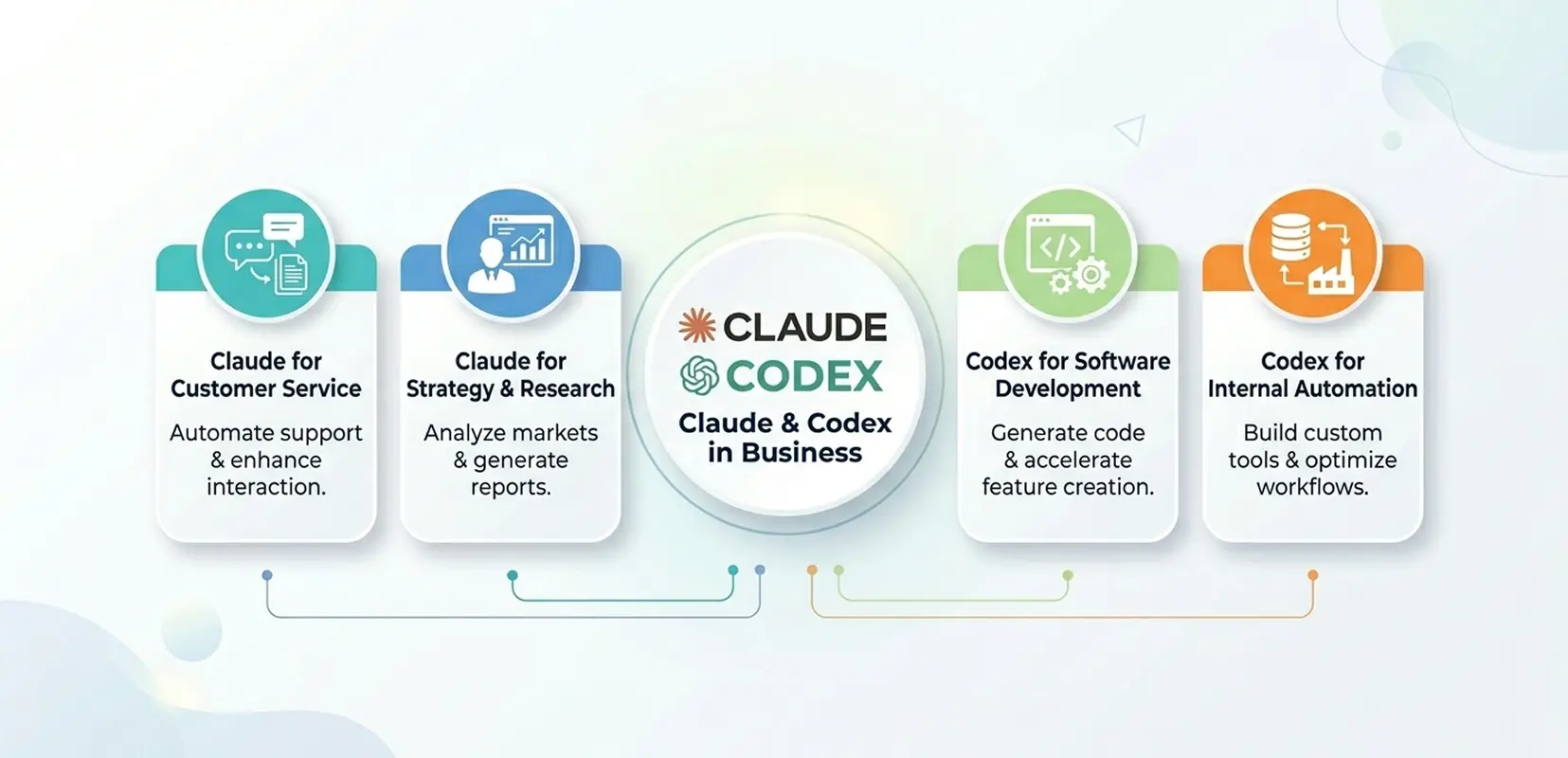
Modern business actively implements artificial intelligence to optimize processes and reduce costs.
Automation of customer support
AI assistants can answer customer questions 24/7. This allows to:
- Reduce the load on operators;
- Accelerate request processing;
- Improve service;
- Lower company expenses.
For example, online stores use AI bots for automatic replies regarding delivery, product returns, or order status.
Claude is often used to create intelligent chatbots and support systems.
Working with documents
Business works with a large amount of information daily:
- Contracts;
- Reports;
- Technical documents;
- Financial files;
- Presentations.
For example, a financial company can use AI for automatic report analysis and detection of suspicious transactions.
Claude can quickly analyze documents, find key information, and form short summaries.
Digital product development
Codex helps companies faster create:
- Websites;
- Mobile applications;
- CRM systems;
- ERP platforms;
- Internal services;
- Automated systems.
For example, a company can use AI to faster create an internal inventory tracking system or automate the order processing workflow.
AI reduces development time and allows minimizing expenses on IT teams.
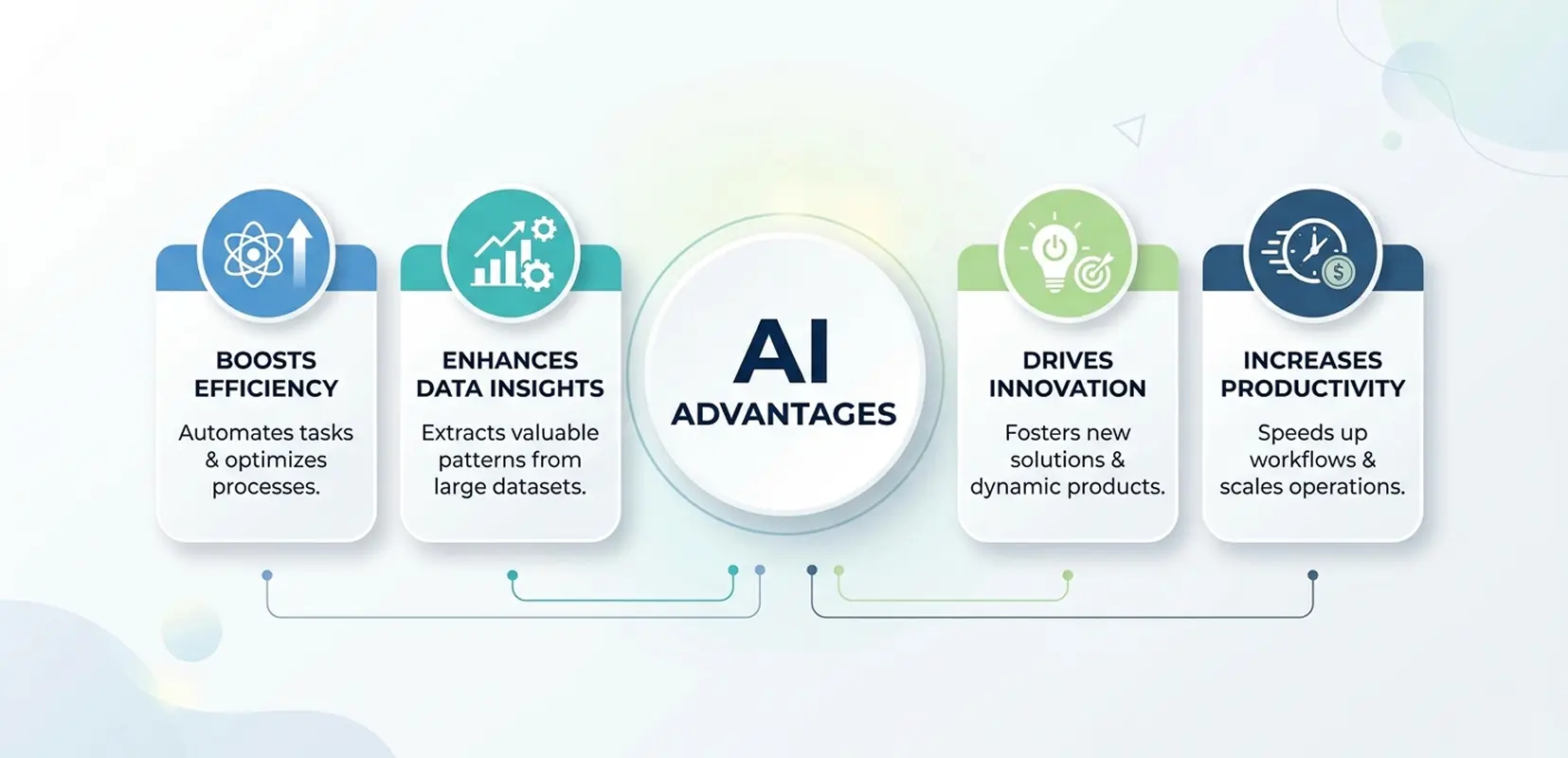
Advantages of using AI
Saving time
AI performs many tasks in seconds. This is especially important for companies where the speed of decision-making is of great importance.
For example, AI can analyze a large array of data in one minute, which would take a human several hours.
Cost reduction
Process automation allows optimizing expenses on:
- Support;
- Development;
- Analytics;
- Document workflow;
- Content.
For example, companies can reduce expenses on processing typical customer requests thanks to AI chats.
Increasing productivity
Employees can focus on more important tasks, while routine processes can be handed over to AI.
For example, marketers can spend more time on strategy rather than manually writing identical product descriptions.
Accessibility of technologies
Previously, complex technologies were available only to large corporations. Today, AI can be used even by small companies and individual specialists.
For example, a freelancer can use AI to create designs, texts, and basic programming without a large team.
Disadvantages and risks of AI
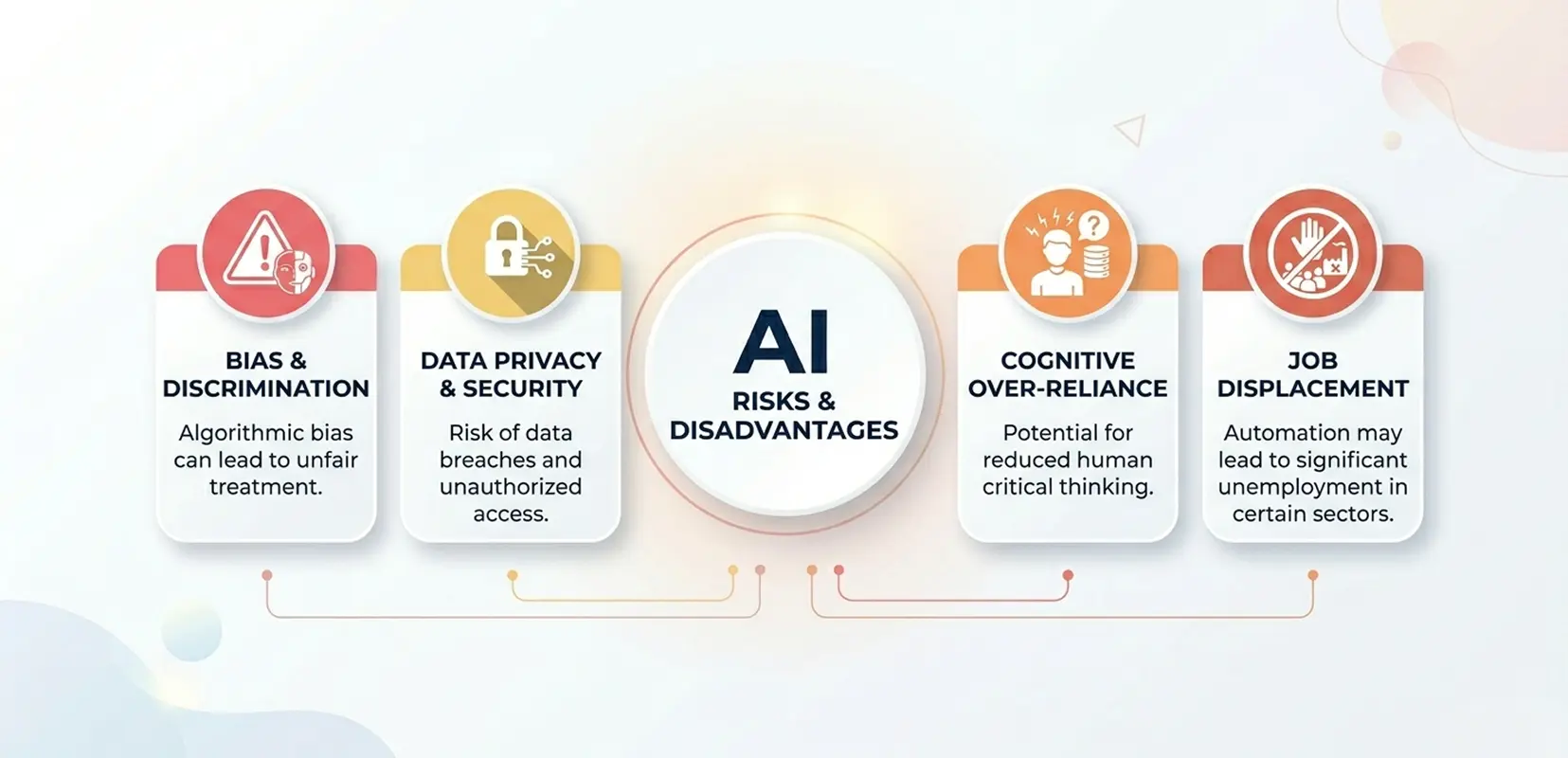
Despite the huge advantages, artificial intelligence also carries certain risks.
Errors in answers
Despite the high level of development of modern artificial intelligence, AI systems are still not perfect and can make mistakes. One of the main problems is that artificial intelligence sometimes generates incorrect, inaccurate, or even completely fabricated information. Such errors can occur due to model limitations, insufficient data relevance, or incorrect interpretation of the user's prompt.
AI errors become especially dangerous in fields where the accuracy of information is of critical importance:
- Programming;
- Medicine;
- Finance;
- Jurisprudence;
- Cybersecurity;
- Public administration;
- Technical documentation.
For example, AI can create code that looks correct at first glance but contains hidden bugs or security vulnerabilities. In small projects, this may lead only to minor glitches, but in large corporate systems, even a single error can cause serious financial losses or data leaks.
In the field of programming, Codex and other AI tools can:
- Generate inefficient code;
- Use outdated libraries;
- Create dangerous SQL queries;
- Leave vulnerabilities in authentication;
- Work incorrectly with databases;
- Create an overly complex project structure.
For example, AI can automatically write a user login system without proper password protection or access verification. If the programmer does not notice the problem, hackers can gain access to user accounts.
Another problem is the so-called AI "hallucinations"—situations where the system confidently provides false information. For example, AI can invent non-existent facts, links, statistics, or even technical documentation. For a person who does not have enough experience in the topic, such information may look completely credible.
In business, this also creates risks. For example, a company can use AI to automatically create financial reports or analytics. If the system processes data incorrectly, it can affect strategic decision-making.
In medicine, AI errors can be even more dangerous. For example, incorrect analysis of symptoms or medical data can lead to a wrong diagnosis or incorrect treatment recommendations.
The problem also lies in the fact that AI does not "understand" information the way a human does. Artificial intelligence analyzes large datasets and predicts the most probable answer, but it cannot always evaluate the context, logic, or real-world consequences of its decisions.
That is why the results of AI work must be checked by specialists. This is especially important in areas where any mistake can affect safety, finance, or human lives.
To minimize risks, companies usually use:
- Manual verification of AI answers;
- Testing of generated code;
- Security auditing;
- Double control of important decisions;
- Training employees to work with AI;
- Limiting AI access to critical systems.
Despite all risks, artificial intelligence remains a powerful tool, but its effectiveness directly depends on how well a human controls and verifies the results of its work.
Security questions
Despite the rapid development of artificial intelligence, the question of security remains one of the most important aspects of using AI in the modern world. The more companies integrate Claude, Codex, and other AI systems into their business processes, the more risks arise related to data protection, information confidentiality, and cybersecurity.
Today, AI is actively used to work with large arrays of information, among which there may be:
- Personal data of clients;
- Banking information;
- Medical records;
- Corporate documents;
- Commercial secrets;
- Software code of companies;
- Internal financial reporting.
If such information falls into the hands of third parties, it can lead to serious financial and reputational losses.
For example, a large company may use AI to automatically analyze internal documentation. If an employee accidentally uploads a confidential file to an unreliable service or incorrectly configures system access, the data may end up in the public domain.
Security issues are especially important for:
- Banks;
- Medical institutions;
- Government organizations;
- Logistics companies;
- IT corporations;
- The military sphere;
- ECommerce platforms.
In the banking sector, AI can analyze transactions and detect fraudulent operations. However, if the system is hacked or misconfigured, attackers can gain access to customer accounts or financial data.
In medicine, artificial intelligence is used to analyze medical histories, examination results, and diagnosis. But a leak of such information is a serious violation of patient confidentiality.
Another problem is the generation of dangerous or vulnerable code. Codex can significantly accelerate software development, however, AI does not always take into account all aspects of cybersecurity.
For example, AI can:
- Create code with vulnerabilities;
- Use outdated libraries;
- Generate dangerous SQL queries;
- Incorrectly configure authentication;
- Leave open API keys in the code.
If a programmer fully trusts the AI and does not check the result, it can lead to serious security problems.
For example, in a web application, AI can automatically create an authorization form without proper protection against SQL injections. As a result, hackers can gain access to the user database.
There is also the problem of social engineering and misinformation. Modern AI is capable of creating very convincing texts, letters, and messages. Scammers can use these capabilities for:
- Phishing attacks;
- Forgery of messages;
- Creation of fake news;
- Deceiving users;
- Manipulations in social networks.
For example, an attacker can use AI to create a fake letter from a bank or a company manager, which will look as realistic as possible.
Another important aspect is the dependence of companies on cloud AI services. If an AI platform temporarily stops working or suffers a cyberattack, business processes may stop.
For example, if a company automated customer support through AI bots, a service failure could lead to a complete halt in communication with clients.
To minimize risks, companies implement:
- Multi-level data protection;
- Information encryption;
- Data backup;
- Audit of AI systems;
- Access control;
- Verification of AI code by specialists;
- Cybersecurity policies.
It is also important that AI is used only as an auxiliary tool, and final decisions are made by humans.
In the future, the question of AI security will become even more urgent, as artificial intelligence will integrate deeper into finance, medicine, transport, public administration, and critical infrastructure.
Technology dependence and further code support using AI
One of the most important problems of modern artificial intelligence is the gradual formation of human and corporate dependence on AI technologies. Today, Claude, Codex, and other systems significantly simplify the work of programmers, analysts, and businesses, however, over-reliance on AI can create new difficulties in the future.
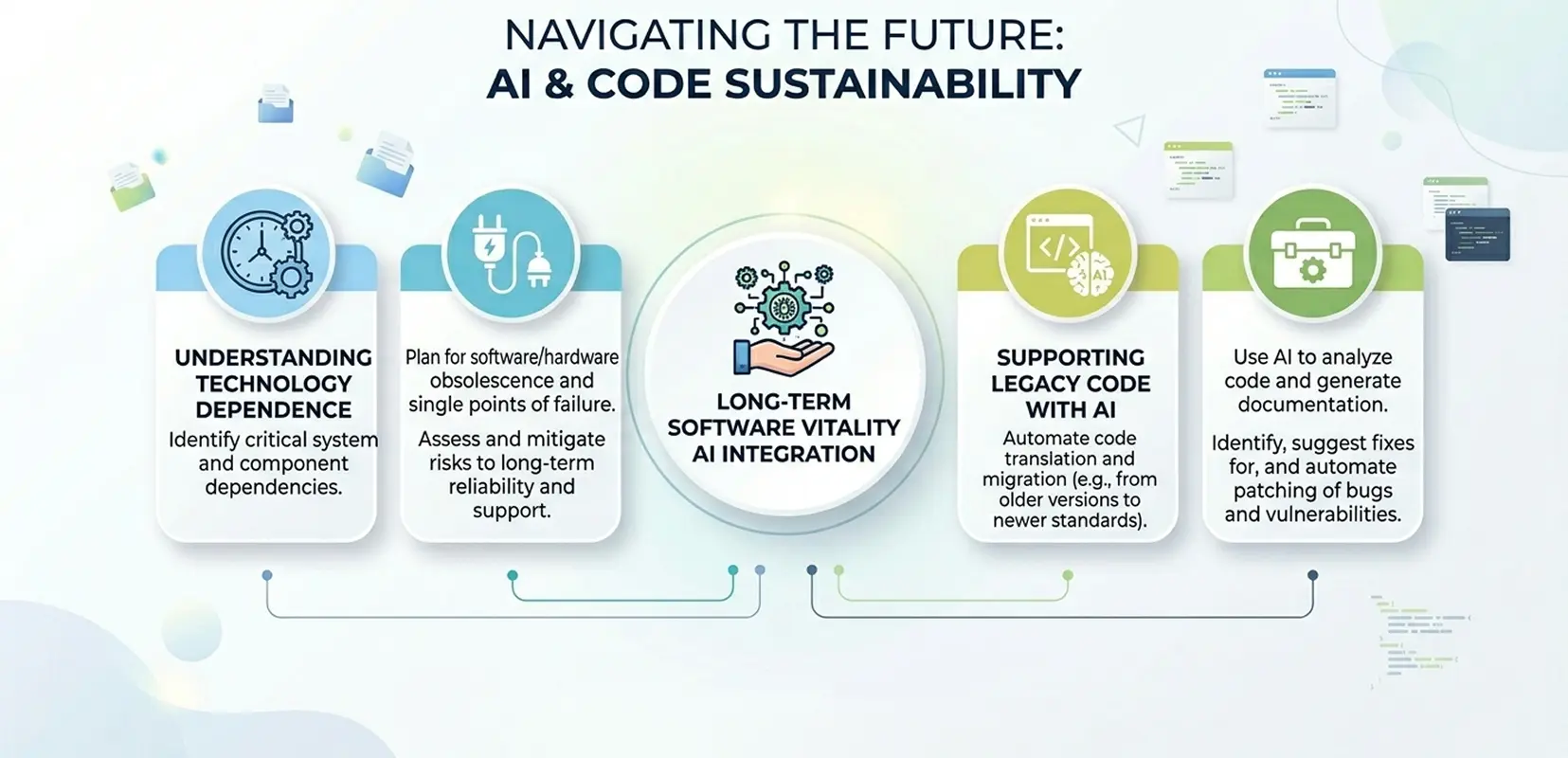
This is especially noticeable in the field of programming. Modern AI systems are capable of:
- Generating large code fragments;
- Automatically fixing errors;
- Creating project architecture;
- Writing documentation;
- Applying algorithms;
- Automating testing.
On the one hand, this significantly accelerates development. But on the other hand, programmers may gradually lose the skills of independent writing and analyzing code.
For example, a young developer who constantly uses AI to generate functions may not fully understand the principles of algorithm operations or software structure.
As a result, a problem of "blind trust" in AI arises. A person uses ready-made code but does not always check:
- Security;
- Performance;
- Logic of operation;
- Compatibility with the project;
- Possible errors.
This is especially dangerous in large projects where even one mistake can cause serious consequences.
For example, AI can automatically generate a user authorization system, but at the same time leave a critical vulnerability in the password verification mechanism. If the team does not notice the problem, the system will become an easy target for hackers.
Another problem is code support in the future. Often AI generates code quickly, but not always optimally or understandably for other developers.
For example:
- The code may be too complex;
- The project structure may be chaotic;
- The logic may be insufficiently documented;
- Variable names may be unclear;
- The architecture may be poorly scalable.
In the short term, this saves time. But in a few months, supporting such a project can become very difficult.
For example, a company created an internal CRM system using AI. For the first few months, everything worked well, but after a system update, other programmers could not quickly understand the logic of the AI code. As a result, support and refinement began to take more time than traditional development.
Another problem is the dependence of business on specific AI services. If a company completely built its workflows around one AI tool, risks arise regarding:
- Price changes;
- Functional limitations;
- Technical failures;
- Loss of access to the service;
- Changes in platform policy.
For example, if an AI service stops supporting a certain programming language or integration, the company will have to urgently rebuild part of its processes.
There is also a psychological aspect of dependence. People gradually get used to the fact that AI performs complex analytical work for them. Because of this, the following may decrease:
- The level of critical thinking;
- Attentiveness;
- Analysis skills;
- The ability to independently solve problems.
This is especially relevant for young specialists who are just starting their careers in the IT field.
Despite this, AI is not necessarily a threat to programmers or business. The best approach is to use artificial intelligence as an auxiliary tool, rather than a complete replacement for human expertise.
Experienced companies are already forming new rules for working with AI:
- Mandatory verification of AI code;
- Code review by the team;
- Security testing;
- Documentation creation;
- Project architecture control;
- Training employees to work with AI.
In the future, the most valuable specialists will not be those who fully rely on AI, but those who know how to effectively combine their own knowledge with the capabilities of artificial intelligence.
Ethical questions
AI creates new challenges for society:
- Copyright;
- Replacement of workers;
- Responsibility for mistakes;
- Confidentiality of information.
For example, in many countries, the issue of copyright for content created by AI is already being actively discussed.
Therefore, the development of artificial intelligence requires not only technological but also legal regulation.
The future of Claude and Codex
Experts believe that in the coming years, artificial intelligence will become even more integrated into daily life.
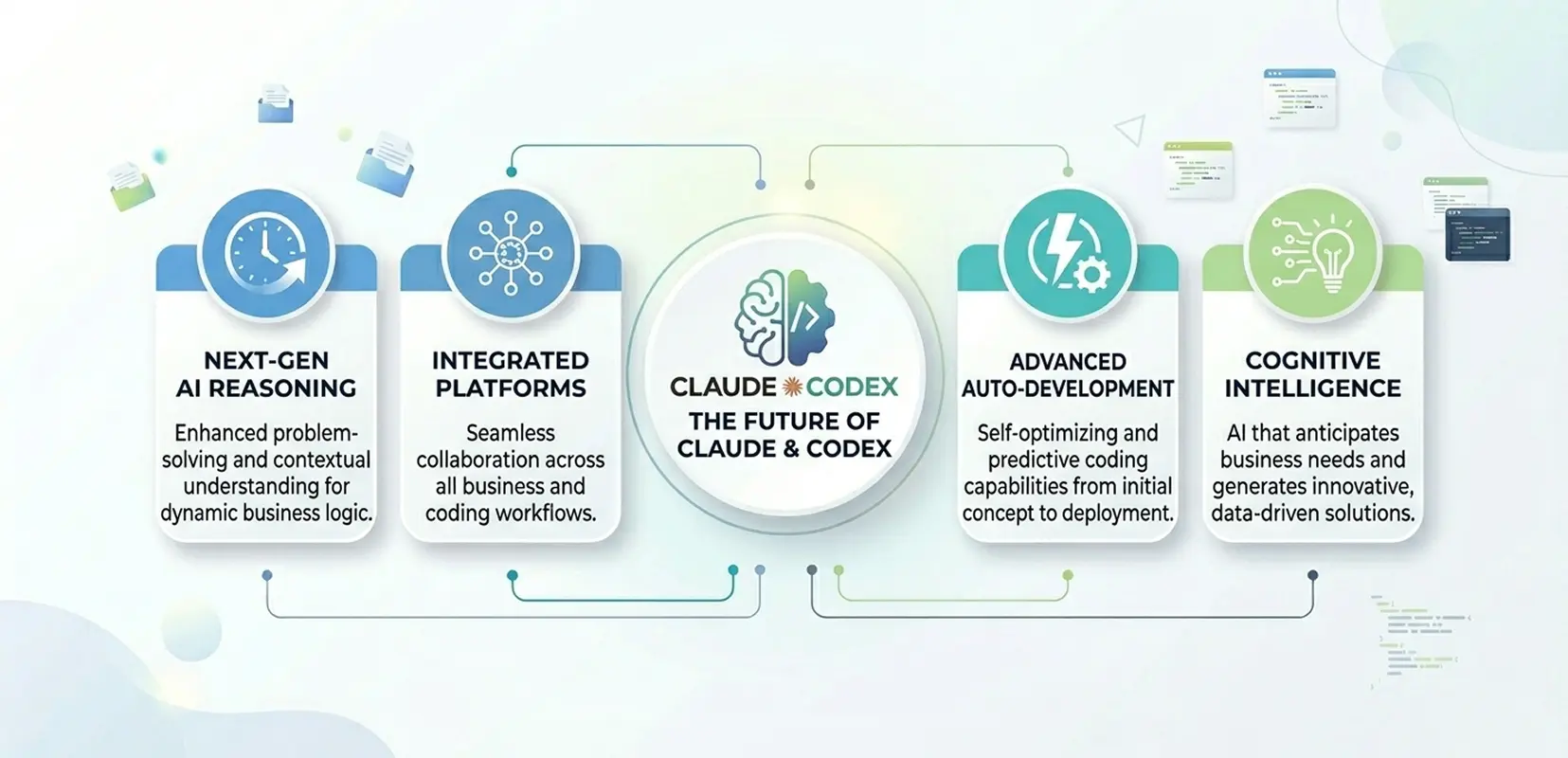
Claude and Codex can significantly change:
- Education;
- Programming;
- Business;
- Medicine;
- Finance;
- Logistics;
- Manufacturing;
- Marketing.
For example, in medicine, AI can help doctors analyze examination results, and in logistics, it can optimize delivery routes.
It is expected that AI will:
- Understand context better;
- Work faster;
- Analyze information more accurately;
- Automate complex processes;
- Integrate into corporate systems.
In the future, AI can become a full-fledged digital assistant for every person.
AI impact on the labor market
The spread of Claude and Codex is already affecting the modern labor market. Some professions are gradually transforming, while new specialities, on the contrary, are becoming more in demand.
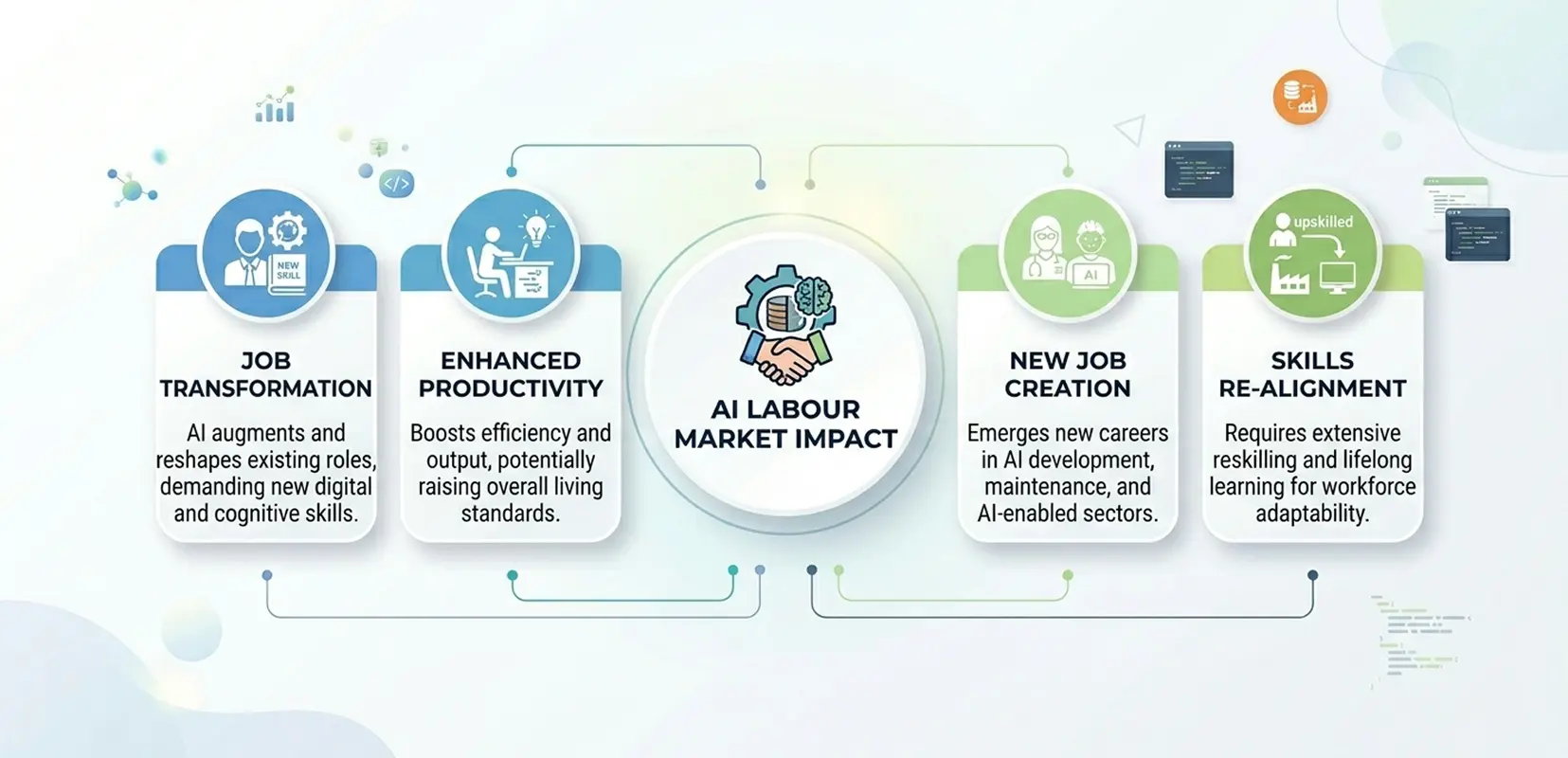
Today, the demand is especially growing for:
- AI engineers;
- Data analysts;
- DevOps specialists;
- Cybersecurity specialists;
- AI copywriters;
- Automation specialists.
For example, many companies are already opening separate vacancies for integrating AI into internal business processes.
At the same time, artificial intelligence will not necessarily fully replace people. Most often, AI becomes a tool that helps workers work faster and more efficiently.
Companies that are the first to adapt to new technologies receive a significant competitive advantage.
Why is it important for business to implement AI today?
Global competition forces companies to constantly optimize processes. The use of AI is no longer just a trend—it is a strategic necessity.
Advantages for business:
- Faster task execution;
- Process automation;
- Cost reduction;
- Improving service quality;
- Fast scaling;
- Increasing team efficiency.
For example, companies that were the first to implement AI automation can already process more orders at lower costs today.
Companies that ignore AI risk losing competitiveness in the coming years.
Conclusion:
Claude and Codex have become important stages in the development of modern artificial intelligence. They demonstrate how strongly AI already affects programming, business, education, and the digital economy today.
Claude helps to effectively work with information, analyze texts, and automate communication. Codex, in turn, changes the approach to programming and significantly accelerates software development.
For example, today even small companies can use AI to automate customer support, create content, and develop digital products without high expenses.
Despite certain risks and challenges, artificial intelligence opens up huge opportunities for companies, specialists, and ordinary users. AI technologies continue to actively develop, and already in the coming years, they will become an integral part of most business processes.
The modern world is entering a new era of digital transformation, where Claude, Codex, and other AI systems are shaping the future of technology, economy, and society.
Editors of KossaSoft
 226
226


READ ALSO
 June 4, 2026
NVIDIA officially unveils RTX Spark: a new era of AI PCs and a major challenge to Intel, AMD, and Apple.
The personal computer industry is on the verge of a major transformation. NVIDIA has officially introduced its new RTX Spark processor — an innovative superchip designed for laptops and compact PCs that could dramatically reshape the Windows device market.
Read moreMarch 27, 2026
How antivirus software works on Windows: a detailed breakdown of virus detection, vulnerabilities, and modern application behavior.
Antivirus software on Windows is no longer just a “file scanner,” but a complex system combining artificial intelligence, behavioral analysis, and cloud technologies that protect billions of computers daily from millions of new threats.
Read moreMarch 18, 2026
Which web developers will be in demand over the next 10 years?
The world of technology changes faster than internet memes. Just yesterday everyone was learning jQuery, today it's React, and tomorrow… well, artificial intelligence might be writing code — actually, it already is 😅 So a logical question arises: which direction in web development will remain relevant in the long term?
Read moreFebruary 10, 2026
Android changes its memory standard: what does the transition to 16 KB pages mean?
A clear guide for React Native developers and their clients.
Read moreDecember 2, 2025
HTML and CSS in 2025: innovations worth paying attention to.
In web development, CSS and HTML continue to evolve, adding features that were previously available only through JavaScript — or not implemented at all. Recent publications show that 2025 is the perfect time to refresh your knowledge and integrate new capabilities into your projects.
Read moreNovember 17, 2025
ASUS laptop with artificial intelligence: What it can do and what to watch out for.
In 2024–2025, laptops are undergoing fundamental changes—they are no longer just tools for web browsing, office work, or watching videos, but true “smart assistants” capable of processing artificial intelligence (AI) tasks directly on the device. Such devices are called AI-ready laptops. ASUS is one of the pioneers of this trend, offering a series of new laptops optimized for AI computations.
Read moreOctober 31, 2025
OpenAI Atlas: A new stage in the evolution of AI-powered browsers.
In October 2025, OpenAI, the creator of the world-famous ChatGPT, unveiled its own web browser — ChatGPT Atlas. This isn’t just another competitor to Chrome or Safari — Atlas aims to redefine how humans interact with the internet. Its main concept is to make artificial intelligence not an add-on to the browser but its core element.
Read moreOctober 15, 2025
Gemini Enterprise — Google’s step toward bringing AI into everyday work.
In today’s world, intelligent technologies are becoming deeply integrated into the daily operations of companies. Google’s new product — Gemini Enterprise — aims to make artificial intelligence not just a tool for experts but an everyday assistant for every employee.
Read moreOctober 1, 2025
Ray-Ban Meta (Gen 2) and Ray-Ban Display: The new generation of smart glasses from Meta
Recently, Meta, in collaboration with Ray-Ban and EssilorLuxottica, unveiled new smart glasses models — Ray-Ban Meta (Gen 2) and Ray-Ban Display (with a built-in projection screen). In this article, we’ll cover technical specifications, features, pricing, limitations, and the potential impact of these new models.
Read moreSeptember 19, 2025
Apple presentation: new AirPods Pro 3 will eliminate the “language barrier”.
At Apple’s annual presentation, alongside new iPhones and other devices, the company unveiled the AirPods Pro 3 — headphones that open up an entirely new era of communication.
Read moreSeptember 15, 2025
Apple introduced the iPhone 17: First photos, price, and detailed overview of the new devices.
Apple has once again shaken the tech world by officially unveiling its new series of smartphones — the iPhone 17. The lineup includes four models: iPhone 17, iPhone 17 Pro, iPhone 17 Pro Max, and an unexpected newcomer — iPhone Air.
Read moreSeptember 1, 2025
Rive.app — a revolution in creating interactive animations.
In today’s digital world, simple static design is no longer enough to capture users’ attention. Animations have become an integral part of websites, mobile apps, and games. They add dynamics, highlight brand style, and make interactions more engaging. This is where Rive.app comes into play — an innovative platform that allows designers and developers to create interactive 2D animations in real time, combining ease of use with powerful capabilities.
Read moreAugust 14, 2025
Next-generation voice recorders: Plaud Note AI vs Plaud.AI Note Pin Gray — which one to choose?
In an era where the speed of receiving and processing information defines success, voice recorders with built-in artificial intelligence are becoming indispensable tools. The Plaud NOTE AI and Plaud.AI Note Pin Gray are two modern devices that combine high-quality recording with intelligent analysis features. In this article, we will compare their capabilities, pros, and cons to help you make the right choice.
Read moreAugust 2, 2024
15 powerful AI services for optimizing business processes.
In today's world, artificial intelligence (AI) has become an indispensable tool for many companies, helping them optimize business processes and reach new heights.In this article, we will explore 15 powerful AI services that can transform your business, making it more productive and competitive.
Read moreMay 14, 2024
The state of Ukrainian IT exports in the first quarter: a comparison with the previous year.
"Every month of the first quarter is worse than this period last year." What is happening with Ukrainian IT exports.
Read moreApril 30, 2024
Jack Dorsey’s company Block has introduced a mining chip using a 3nm process.
Block, founded by Jack Dorsey, a prominent entrepreneur and co-founder of Twitter, has unveiled its latest breakthrough in the cryptocurrency sphere - a mining chip utilizing a 3nm process.
Read moreApril 23, 2024
Imparta introduces the world’s first AI that understands sales methodology.
Imparta, a leading sales training and consulting company, recently launched a groundbreaking advancement in the field of artificial intelligence (AI).
Read moreJanuary 29, 2024
TikTok: The new Google? Adobe research.
In a world of rapid technological advancement, each day brings forth new trends and phenomena. In this context, TikTok, an innovative social platform, is gaining momentum, prompting the question: can it become the "new Google" in the realms of marketing and video content?
Read moreJanuary 24, 2024
What IT specialists will be in demand in 2024?
In 2024, the information technology industry will continue its rapid development, leading to an increased demand for diverse professionals in the IT field. Let's explore the key directions and specialties that will be particularly sought after in this dynamic and innovative sector.
Read moreJanuary 17, 2024
IBM has achieved a quantum breakthrough by creating the world’s second-largest quantum computer: 1,121 qubits unveiled.
IBM has announced the activation of its cutting-edge 127-qubit Quantum Eagle platform at the University of Tokyo, marking the deployment of the most powerful quantum computer in the region.
Read moreJanuary 12, 2024
Updates in the field of computer programming: Latest languages and frameworks.
In the world of computer technologies, where innovation is a daily occurrence, computer programming is advancing on an exciting path. In this article, we will explore the latest updates in the realm of programming languages and frameworks that shape the current trends in software development.
Read moreDecember 29, 2023
MidJourney v6: Breakthrough in the world of artificial intelligence image generation.
With incredible achievements in the field of artificial intelligence, developers have unveiled MidJourney v6 to the world—a new model capable of generating photorealistic images, captivating users with its boundless creativity and precision.
Read moreDecember 20, 2023
United Kingdom building a powerful supercomputer with artificial intelligence processing 200 quadrillion calculations per second.
In the innovative realm of technology, the United Kingdom is captivating the world with its ambitious project to construct a formidable supercomputer, promising to revolutionize the understanding of computation and artificial intelligence.
Read moreDecember 15, 2023
Google Bard chatbot now powered by Gemini Pro.
In a world of rapid technological advancements and continual refinement of intelligent solutions, Google has taken a step into the future by upgrading its renowned chatbot Bard.
Read moreDecember 11, 2023
Hitachi Vantara unveils Pentaho+: a streamlined platform for generative artificial intelligence.
In the rapidly evolving landscape of technology, finding tools that meet the demands of modern business is crucial. Hitachi Vantara is elevating the capabilities of data analytics and artificial intelligence with the introduction of its integrated development environment—Pentaho+.
Read moreDecember 6, 2023
Apache NetBeans 20: Integrated development environment with new features.
Apache NetBeans, a popular Integrated Development Environment (IDE), has announced the release of its latest version - Apache NetBeans 20. This update introduces a range of innovations and improvements aimed at simplifying developers' work and enhancing project productivity.
Read moreNovember 29, 2023
Orion browser: Enhancing macOS browsing experience with ad and tracker blocking.
In the modern world, where the internet plays a crucial role in our everyday lives, choosing the right browser becomes an increasingly important task. One of the promising alternatives for macOS users is the Orion browser, which not only offers excellent speed performance but also emphasizes providing a high level of security and privacy.
Read moreNovember 24, 2023
Pixel Perfect: How to apply a layout to code with precision.
Pixel Perfect is a development methodology aimed at achieving maximum accuracy in reproducing the design during the layout of websites or applications. Let's explore the steps that will help you successfully implement Pixel Perfect into your project.
Read moreNovember 20, 2023
Swift Utilities: Working with dynamic colors.
Swift Utilities, a reliable and powerful library for iOS developers, impresses with its capabilities in handling dynamic colors. Let's explore how this tool simplifies the lives of developers and enables the creation of applications with stunning designs.
Read moreNovember 15, 2023
Gravity UI design system: Ease in building your interface.
Design systems have become an integral part of interface development, enabling the creation of convenient and stylish applications. One such system is "Gravity UI," which has gained recognition for its ease of use and efficiency in development.
Read moreNovember 10, 2023
Essential soft skills for a Senior developer: Key skills for a successful career.
Technical skills are undoubtedly crucial for a Senior developer, but the successful career development in this field also relies on the effective mastery of soft skills. Let's explore five key soft skills that are important for a Senior developer.
Read moreNovember 6, 2023
Siemens and Microsoft are joining forces to create smart solutions based on artificial intelligence.
Recently, Siemens and Microsoft announced their strategic partnership aimed at creating advanced solutions based on artificial intelligence (AI) that will unlock new possibilities in various industries and transform the approach to manufacturing and automation.
Read moreNovember 1, 2023
Elon Musk’s ambitious plan for an “All-encompassing app” for X.
Entrepreneur and inventor Elon Musk, known for his involvement in prominent companies such as Tesla and SpaceX, has announced his intention to create an "all-encompassing application" for an undisclosed purpose. This news has sparked significant interest and curiosity within the public and the tech community.
Read moreOctober 27, 2023
IP Protection in Google Chrome: A new feature for user privacy.
Recently, Google announced the testing of a new feature - "IP Protection." This feature is designed to conceal users' IP addresses while browsing websites.
Read moreOctober 23, 2023
Foxconn and Nvidia join forces to create fab II: The future of manufacturing and innovation.
In September 2023, the technology industry is experiencing a new revolution through the collaborative initiative of two major companies, Foxconn and Nvidia. This partnership is aimed at creating impressive "Fab II" facilities, which promise to reshape the landscape of manufacturing and innovation.
Read moreOctober 16, 2023
The future of the metaverse: What’s changing in Meta’s chip development?
The year 2023 has brought significant changes to the world of technology, particularly in the development of chips for the metaverse.
Read moreOctober 13, 2023
Intensified сompetition for viewer attention: YouTube surpasses Netflix among teenagers.
In the modern digital age, media platforms are in fierce competition for viewers' attention, especially among the younger generation. Recently, YouTube, the renowned video hosting platform, has surpassed Netflix in popularity among teenagers.
Read moreOctober 9, 2023
Google launches enhanced assistant with generative AI.
Google continues to revolutionize the world of artificial intelligence and machine learning with the introduction of its new assistant, powered by Generative AI (Generative Artificial Intelligence, GAI).
Read moreOctober 4, 2023
TikTok tests ad-free subscription for $4.99 per month.
TikTok, one of the world's most popular social media platforms, is experimenting with a new way to cater to its users' needs.
Read moreOctober 2, 2023
40 years of Microsoft Word: How to determine its birthdate.
Microsoft Word, one of the most popular word processors in the world, is celebrating its 40th anniversary.
Read moreSeptember 29, 2023
Vivaldi browser lands on iPhone and iPad with built-in tracker and ad blocker.
Vivaldi has expanded its reach by launching versions for iPhone and iPad.
Read moreSeptember 27, 2023
ChatGPT expands its capabilities: Now with voice and images.
OpenAI's ChatGPT has further improved it now allows communication through voice and images.
Read moreSeptember 25, 2023
Intel announces release of Meteor Lake processors on december 14.
Intel, one of the leaders in processor manufacturing, has announced that its long-awaited Meteor Lake processors will be unveiled on December 14 this year.
Read moreSeptember 22, 2023
Payment of administrative fines in “Diia”: Ministry of digital transformation launches beta test of new service.
The Ministry of Digital Transformation of Ukraine is working on the implementation of a new service - the payment of fines for administrative offenses in the "Diia" app.
Read moreSeptember 20, 2023
Google allows the use of texts from ChatGPT: Broad opportunities and new perspectives.
Google, one of the world's largest technology companies, has taken a significant step in the development of artificial intelligence and natural language processing (NLP). The company has officially allowed the use of texts created by artificial intelligence, including the ChatGPT system, for various purposes. This move opens up endless possibilities for the use of artificial intelligence in many fields.
Read moreSeptember 18, 2023
Self-development in IT: how to stay in trend and not burn out?
For professionals in the IT field, it is important not only to possess current skills but also to constantly self-improve in order to stay current and avoid burnout. In this article, we will explore key self-development strategies in the IT industry.
Read moreSeptember 15, 2023
Apple рекомендує не коментувати рівень випромінювання iPhone 12 та інших гаджетів: Деталі та Перспективи.
Вперше в історії Apple компанія рекомендує своїм співробітникам техпідтримки та магазинів утриматися від коментарів про рівень випромінювання її продуктів, зокрема iPhone 12 та інших гаджетів.
Read moreSeptember 13, 2023
Google unveils its ChatGPT rival.
Google on Monday unveiled a new chatbot tool dubbed “Bard” in an apparent bid to compete with the viral success of ChatGPT.
Read moreSeptember 11, 2023
An exciting journey to the future: How Meta is developing next-generation artificial intelligence.
Meta is working on next-generation Artificial Intelligence (AI). Developers are confident that with advanced algorithms, the new product will be able to capture a significant share of the market in the coming years.
Read moreSeptember 8, 2023
5 recommended books for those looking to advance their technical IT career.
Developing a successful career in the constantly evolving field of Information Technology (IT) entails continuous learning and growth. One of the most effective ways to enhance your technical skills and knowledge is through reading. In this article, we present five recommended books for those looking to elevate their technical expertise and thrive in the IT industry.
Read moreSeptember 6, 2023
How to turn failure into success: 9 risk rules from the legendary founder of Apple, Steve Jobs.
In this article, we will explore 9 risk rules learned from Steve Jobs, the co-founder of Apple, that help turn failure into success.
Read moreSeptember 4, 2023
How to create a website evaluation survey?
Creating an effective survey to evaluate a website is an important component of improving the user experience and enhancing the impact of your web project. In this article, we will explore the steps and strategies for creating such a survey.
Read moreSeptember 1, 2023
Launching ChatGPT for large enterprises: A game-changing intelligent language model.
OpenAI continues to astonish the world with innovative solutions in the field of artificial intelligence, and this time, they have introduced ChatGPT for Large Enterprises to the market. This new intelligent language model opens up boundless possibilities for businesses to enhance efficiency and automate various aspects of their operations.
Read moreAugust 30, 2023
Recruiter, HR, and Sourcer: Who are they and what are the differences.
During the employee recruitment process, three important roles stand out: Recruiter, HR Manager, and Sourcer. In this article, we will explore what recruiting, HR, and sourcing entail, and delve into the distinctions between these professions and the responsibilities of these specialists.
Read moreAugust 28, 2023
What is Node.js? 20 Useful Node.js Frameworks.
Over the past years, Node.js has significantly elevated its status from an experimental technology to the cornerstone of substantial projects. Above all, Node.js is an utterly captivating entity that makes working with it genuinely fascinating!
Read moreAugust 25, 2023
Giving feedback to employees: a guide for HR specialists.
Feedback from employees is an essential component of corporate culture. It helps employees understand how their actions impact outcomes and work productivity. Establishing a feedback loop is crucial not only for company effectiveness but also for fostering a positive atmosphere within the team.
Read moreAugust 23, 2023
Organization the work of remote teams.
The number of remote teams is growing every year. Remote work has its advantages, but at the same time, questions arise about task management, synchronization of actions, and communication among employees. Fortunately, today there are numerous convenient tools for remote work.
Read moreAugust 21, 2023
How to create an SEO-optimized website: a guide.
Without search engines today, it's simply impossible. In this article, we will tell you how to create a website with SEO parameters in mind and what stages you need to go through before achieving top positions in Google search.
Read moreAugust 18, 2023
The JavaScript language what is it and what is it used for?
Today, we will discuss what the JavaScript programming language represents, its advantages and disadvantages, and where it is used. We promise, it will be interesting!
Read moreAugust 16, 2023
How to create your unique selling proposition and make your business stronger?
The Unique Selling Proposition (USP) is the shortest path to your customer's heart and their wallet. The USP simultaneously sets you apart from all competitors and highlights your unique way of addressing customer needs. In this article, we will discuss how to discover and formulate your unique selling proposition.
Read moreAugust 14, 2023
Which domain to choose for an online store?
Choosing a domain name for your online store is a crucial step that can define its success and recognizability. A well-chosen domain can make your brand easily memorable and set you apart from competitors. In this article, we will explore key aspects of selecting a domain for an online store and provide useful tips for making an effective choice.
Read moreAugust 11, 2023
Web design trends in 2023.
Following web design trends is not just about creating stylish websites, but also about engaging and retaining users through a fresh user experience. In this article, we have analyzed the web design trends of 2023.
Read moreAugust 9, 2023
Game Development: 7 Key Stages of Creating a Mobile Free-to-Play Game.
Game development plays a significant role in the evolution of the entertainment industry in the modern world, and creating mobile free-to-play games poses a particularly exciting challenge. This article will uncover the key stages of this creative and technical process that underlie the successful realization of this captivating goal.
Read moreAugust 7, 2023
Landing Page: what, now, how to create something.
Admit it, you've definitely heard of a Landing Page at least once. The information in this article is suitable for those who are looking to expedite the process of acquiring "hot" clients, leads, and understand all aspects of a Landing Page.
Read moreAugust 4, 2023
How to be effective and more productive as an SMM specialist?
Usually, an SMM specialist has a lot of tasks throughout the day: they need to create a content plan, coordinate it with the team, prepare posts, reels, stories, publish everything, and also not forget about analytics, audience comments, and new creative ideas. How can SMM specialists manage to get everything done, plan their time effectively, and be productive?
Read moreAugust 2, 2023
Why is a corporate identity and how to create it?
Lorem ipsum dolor sit amet, adipiscing elit. Pulvinar duis ullamcorper. Lorem ipsum dolor sit amet, adipiscing elit.Lorem ipsum dolor sit amet, adipiscing elit. Pulvinar duis ullamcorper. Lorem ipsum dolor
Read moreJuly 31, 2023
How React 18 improves app performance.
React 18 introduced concurrent capabilities that radically change the way applications are rendered. In this article, we will explore how these capabilities improve the performance of applications.
Read moreJuly 28, 2023
Who are testers and why are they needed?
QA testers are specialists responsible for ensuring the quality of software by performing various tests and checks. They play a critical role in the software development process, helping to identify defects, ensure high reliability, and meet user needs and satisfaction.
Read moreJuly 26, 2023
What is an offer and how to make it?
Offer (from English "Proposal") is a popular and effective way to promote a business idea. Today, we will delve into what an offer is, how to create one.
Read moreJuly 24, 2023
How to come up with a name for an online store – all about naming.
The naming process can be lengthy and challenging as it requires creativity, analysis, checking the availability of domain names, and considering the legal aspects of using the chosen names. And successful naming can significantly impact the success of a product or brand in the market.
Read moreJuly 21, 2023
Information security and cyber security: how are they mutually exclusive?
Information security and cybersecurity are two distinct fields, but they heavily overlap, creating confusion in understanding the concepts of each. In this article, we will explore information security and cybersecurity in detail, so you can make an informed decision regarding your knowledge and the level of protection for your organization.
Read moreJuly 19, 2023
What is website microdata markup and why is it needed?
Website micromarkup is an essential tool that allows for structuring and defining the meaning of content on web pages using special tags and code. In this article, we will learn all about micromarkup and its role in improving SEO optimization, increasing website visibility in search engines, and enhancing the user experience.
Read moreJuly 17, 2023
This is 80% of what it takes to succeed.” 21 tips from ChatGPT CEO Sam Altman.
Success is the goal we all strive to achieve in various aspects of life. Wouldn't it be great if we had the opportunity to receive valuable advice from an experienced leader? In this article, we will present you with 21 tips from ChatGPT CEO Sam Altman that will help you pave the path to success.
Read moreJuly 14, 2023
How to Find Your Style and Where to Find Inspiration as a Designer.
In search of their own style and inspiration, designers encounter important questions that require deep reflection and exploration. The path to discovering one's own style lies in combining personal preferences, professional skills, and creative vision. Moreover, sources of inspiration for designers can be diverse, ranging from nature and art to fashion trends and contemporary innovations. The internet is an endless ocean of inspiration, so diving into it for ideas is highly encouraged.
Read moreJuly 12, 2023
6 Visual Studio Code Extensions That Will Boost Your Productivity.
Thanks to Visual Studio Code and the abundance of available extensions, we can make the coding process smoother and more productive. Let's take a look at six essential extensions for Visual Studio Code that will undoubtedly enhance your productivity as a developer.
Read moreJuly 10, 2023
The Future of Robotics and Automation in Entertainment.
The Future of Robotics and Automation in Entertainment is approaching with each passing day, bringing forth new technologies and innovations. From gaming consoles to virtual reality, this sector is rapidly evolving and transforming the way we perceive and interact with entertainment experiences. In this article, we will explore how robotics and automation are reshaping various industries and providing new opportunities for immersive and captivating experiences.
Read moreJuly 7, 2023
Twitter has threatened legal action against the company Meta, which launched the Threads service.
Twitter is seeking a legal injunction against Meta, the company behind Threads, for using its intellectual property.
Read moreJuly 5, 2023
How the Internet of Things works: the essence of technology and its application in the modern world.
The number of Internet of Things (IoT) devices has already exceeded 12 billion units and is projected to reach 41 billion by 2025. In this article, we will explain in simple terms what the Internet of Things is and what it entails.
Read moreJuly 3, 2023
What is GitHub Copilot and how to work with it.
In the summer of 2021, one of the largest IT giants, Microsoft, in collaboration with its subsidiary company GitHub, announced the launch of the Copilot system - an AI-powered neural network capable of writing code on behalf of developers.
Read moreJune 30, 2023
IAAS, PAAS, SAAS: WHICH CLOUD MODEL TO CHOOSE FOR YOUR BUSINESS?
According to the forecast by Gartner, total spending on public cloud services is expected to exceed $590 billion in 2023. This projection is based on the greater adaptability of cloud infrastructure compared to on-premises data centers.
Read moreJune 28, 2023
Problem Solving: How to Effectively Solve Problems in a Team?
The ability to timely resolve internal and external product and team problems, as well as making responsible decisions, is something that every beginner product manager should learn right from the start of their career. In this material, we will break down the process of problem-solving and also discuss several effective methodologies and exercises for teamwork.
Read moreJune 26, 2023
Top 10 Best Backend Web Frameworks for Web Development in 2023.
Web development is constantly evolving, and backend web frameworks are an essential component of a successful project. In this article, we will explore the top 10 best backend web frameworks for 2023 that will help you build powerful and scalable web applications.
Read moreJune 23, 2023
Top 5 globally renowned Ukrainian startups.
Ukraine is rightfully recognized as a leading provider of IT services both in peacetime and during times of conflict. The country maintains its image as a professional and reliable supplier, and certain Ukrainian digital products have gained significant recognition worldwide. These companies, which started their journey in Ukraine, have their unique stories and secrets to success. In this article, we will explore five such well-known IT companies.
Read moreJune 21, 2023
How to reduce absenteeism in the workplace?
Absenteeism in the workplace is a serious issue that can negatively impact team productivity and effectiveness. In this article, we will explore some effective strategies for reducing absenteeism and creating a motivating and healthy work environment.
Read moreJune 19, 2023
The guide to SVG: vector graphics in web design and the stages of its creation.
SVG is a powerful tool for creating vector graphics used in web design. This format allows for the creation of scalable graphical images that maintain clarity and detail even when resized. In this guide, we will explore the fundamental concepts and stages of creating SVG graphics, as well as learn how to use them in web design to create stunning and responsive interfaces.
Read moreJune 16, 2023
What is blockchain technology?
Blockchain technology is an innovative approach to storing and transmitting data that is based on a distributed network of computers and ensures security, transparency, and immutability. It revolutionizes the way information is exchanged, opening up numerous possibilities for various industries and activities.
Read moreJune 14, 2023
How to create a business plan correctly.
If you plan to start a serious business involving significant investments, partners, and qualified employees, you cannot do without a carefully thought-out business plan. In this article, we will explain what a business plan is, how to create it correctly, and what its structure should be.
Read moreJune 12, 2023
How to develop and implement corporate culture in a company.
Corporate culture plays a crucial role in the development of a company by creating a favorable work environment, attracting talented employees, and facilitating the achievement of goals. In this article, we will explore the key steps and strategies that will help develop and successfully implement corporate culture in a company.
Read moreJune 9, 2023
Apple has unveiled the Vision Pro mixed reality glasses.
Apple introduced its most talked-about innovation at WWDC2023 - the AR/VR headset, which is named Apple Vision Pro.
Read moreJune 7, 2023
Colors for Logo: Best Shades and Successful Combinations.
A successful logo requires a thoughtful selection of a color palette that reflects the essence of the brand and captures the attention of the audience. The color spectrum for a logo holds significant importance, considering its psychological impact and the potential to create effective color combinations.
Read moreJune 5, 2023
Linux: Advantages of Using the Operating System.
Using the Linux operating system offers numerous advantages that attract users worldwide. In this article, we will explore the benefits of using the Linux operating system and present the ranking of Linux distributions for 2023.
Read moreJune 2, 2023
What types of websites exist?
Every website has its specific goal that developers and clients aim to achieve. These goals can vary: some websites are created for selling products, others help improve communication among employees of large companies, and some are used for conducting marketing campaigns. In this article, we will provide a detailed classification and explore various types of websites based on their objectives.
Read moreMay 31, 2023
How to create a marketplace in 2023.
In 2023, creating a marketplace presents a relevant and exciting opportunity for entrepreneurs and startup founders. With the rapid advancements in technology and shifts in consumer habits, establishing your own marketplace has become more accessible, allowing you to carve out your niche in the online commerce landscape.
Read moreMay 29, 2023
Who is HR manager.
An HR manager is a professional responsible for the strategic management of personnel in a company. They ensure effective recruitment, development, and retention of talented employees, which forms the foundation of the organization's success.
Read moreMay 24, 2023
11 Best Free Animation Libraries for UI Designers.
If you want to incorporate animations into your projects, animation libraries are an excellent resource to consider.
Read moreMay 22, 2023
Adobe Firefly – the next generation of generative AI.
Adobe software for photo/video editing has long relied on the support of Sensei AI, and now the company introduces the next generation of AI capabilities - Firefly generative models that create fonts, images, audio, video, and 3D models.
Read moreMay 19, 2023
What is a CMS for a website?
Content Management Systems (CMS) are powerful tools designed to facilitate the management of websites. They have become an integral part of the modern internet world, and nowadays, many websites are built using CMS. In our material, we will provide a detailed explanation of the essence of CMS, their classification, working principles, advantages, and disadvantages, so that you can gain a better understanding of this fascinating topic.
Read moreMay 17, 2023
How to start a startup?
Today we will talk about startups in plain language. You will learn about all the stages of their development and understand that starting your own business project is not difficult, and finding investors will not be a big challenge. In this article, we will share expert advice on overcoming the difficulties that newcomers face at the initial stage of project development.
Read moreMay 15, 2023
What types of investments exist.
Many people in our society are interested in increasing their financial resources and other material assets. Therefore, they are interested in various investments and successful investing. The classification of investments depends on various factors, such as forms of ownership, investment content, investment terms, and so on. At this stage, we will examine several types of investments in more detail.
Read moreMay 12, 2023
What is needed for team cohesion.
A cohesive team is a key factor in the success of any organization. When people work together, collaborate, and interact, the results of their work can be significantly better than if everyone worked alone. However, team cohesion is not something that can be achieved automatically. It requires time, effort, and interaction to build trust, collaboration, and understanding among team members. In this topic, we will discuss what is needed for team cohesion and how it can improve work performance.
Read moreMay 10, 2023
What is the difference between a PM and an AM manager.
When it comes to software development management, there are several key participants. In the case of IT companies creating products on demand, there is always an account manager role for communication with the customer on all projects. Depending on the complexity of the development, a project manager and team lead may also be involved. Let's take a look at how their tasks differ and on which projects they are needed.
Read moreMay 8, 2023
Attracting investments in IT.
oday we will talk about how to build relationships between an investor and a developer and their team so that investments work to maximize profit.
Read moreMay 5, 2023
Meta plans to release revolutionary AR glasses by 2027.
American company Meta plans to release its first full-fledged augmented reality (AR) glasses in 2027, which, according to the creators' vision, will eventually become as popular as mobile phones.
Read moreMay 3, 2023
Flair – a generator of beautiful backgrounds for products based on artificial intelligence.
This is an AI-powered tool that simplifies the process of creating product photos. Users can combine branded elements, products, accessories, and backgrounds on a canvas. The AI fills in the spaces, creating attractive scenes.
Read moreMay 1, 2023
Ukrainian engineers listed 5 innovations that are changing the world of retail.
The retail market, which has already reached $27.34 trillion per year, continues to grow at a rate of 3-5% annually. To maintain such growth rates, businesses are increasingly using cutting-edge technologies.
Read moreApril 28, 2023
How to clear the browser cache?
Modern browsers are convenient and efficient tools for users, as they quickly load pages, images, and videos. Caching is one of the technological solutions that help with this. What is caching, why is it sometimes necessary to clear the cache, and how can it be done?
Read moreApril 26, 2023
Which messenger to choose in 2023: advice and recommendations.
A modern person can hardly imagine their life without the Internet, smartphone, or computer. With the help of these tools, people work, have fun, learn, and, of course, communicate with friends. Ordinary SMS messages have long been a thing of the past, giving way to dozens of messengers that have countless additional features. Let's take a closer look at the most popular messengers in the world.
Read moreApril 24, 2023
Frontend and design: key factors of a successful project.
No matter the size of the team or project specifics, similar problems always arise: mistrust or biased attitudes between frontend developers and designers, misunderstanding of layouts or design systems, ineffective communication within the team, and other factors that make the work more challenging. This material will be useful for both frontend developers and designers.
Read moreApril 23, 2023
Steve Jobs’ motivational speech at Stanford.
Steve Jobs' motivational speech at Stanford is one of the most famous and influential motivational speeches in history. The speech was delivered on June 12, 2005 to graduates of Stanford University.
Read moreApril 21, 2023
Creating a positive work environment to increase employee motivation.
Low employee motivation can seriously impact the productivity of a small business as a whole. Managers of small enterprises with a small number of employees do not always know how to create an effective motivation system, which can lead to financial losses and decreased performance. Let's consider the steps that can be taken to prevent this.
Read moreApril 19, 2023
What operating system to choose for programming?
Many technical specialists, including beginners in the IT industry, are interested in which operating system - Linux, Windows, or macOS - is best suited for development and engineering work. To give an objective assessment of the advantages and disadvantages of each, we asked experienced senior-level experts for their opinions and experience using these operating systems.
Read moreApril 17, 2023
Three professions of the near future that are relevant already now.
If you thought that programming languages were the most important thing in the IT industry, it is worth paying attention to other professions that are also necessary. Among them, information security and project management can be highlighted, which have low competition in the market. Learn and get an advantage in the job market.
Read moreApril 16, 2023
Why corporate events are important.
Before the holiday season, company leaders often consider the need for corporate events for employees. Organizing corporate events is an effective way to increase productivity and reduce stress in the team. The main goal of such events is to change the usual work environment.
Read moreApril 14, 2023
Effective communication with foreign clients: how to overcome the time difference.
Working with foreign clients in different time zones requires some adjustments. Technological advancements allow companies to find experts from anywhere in the world and provide significant opportunities for collaboration with foreign clients. However, it is essential to consider the time difference and plan meetings and communication in advance.
Read moreApril 12, 2023
What is needed to work as an IT specialist.
In every profession, there are tools that are necessary, and software developers are no exception. A great programmer is familiar with their tools and uses more powerful and advanced ones than an average programmer. There are certain tools that every software developer should know how to use, and here is a list of such tools.
Read moreApril 10, 2023
UI/UX design and web design: main differences.
The profession of UI/UX designer is becoming increasingly popular with the rapid growth of the digital industry. But what does this abbreviation actually mean and what is the difference between it and web design?
Read moreApril 9, 2023
Collaboration in Business: 5 Effective Models to Strengthen Your Company.
Likely, every entrepreneur faces challenges in their relationships with their business partners. And although it's good when these challenges are discussed and resolved, there are situations when conflicts drive people apart and harm the business.
Read moreApril 7, 2023
Relevant design elements nowadays.
The success of a website depends on the quality of its design, so it is important to keep up with the latest trends in web design and use current tools. Trends in this industry change every year, so it's important to stay up to date with the latest news. As a designer or business owner, you should familiarize yourself with new trends in order to create not only an effective website, but also a favorable impression of your company.
Read moreMarch 27, 2023
IT job market during war.
Russian aggression has caused hiring freezes or staff reductions in Ukrainian companies, leading to job losses for about 40% of the population. However, the IT sector has been one of the few industries in Ukraine that has been able to quickly resume hiring and maintain salaries at previous levels.
Read moreMarch 27, 2023
16 best startups in the world for 2023.
The year 2022 proved to be challenging for the country, all Ukrainians, and particularly for the IT industry. We decided to analyze what to expect from the industry during the upcoming year of 2023. After communicating with representatives of government institutions, clusters, companies, and IT professionals about the challenges that await the IT industry in the future, we explore whether the industry can restore growth, retain and attract new clients and key developers.
Read moreMarch 24, 2023
Chatbot Bard from Google.
Google has launched its own chatbot called Bard, which, like the well-known ChatGPT, is based on artificial intelligence (AI) principles. So far, Bard is only available in the US and the UK and only to users over 18. The developers refer to it as an experiment and, while highlighting its advantages over ChatGPT, also warn of its drawbacks.
Read moreMarch 21, 2023
Top 10 most popular programming languages in 2023.
Learning programming in Ukraine has never been as popular as it is now. Many people wonder how to become a programmer and which programming language to learn in 2023. The choice of programming language depends on what exactly you want to do: develop mobile applications, websites, desktop applications, machine learning models, or other things. Below are the best programming languages that are in demand among employers in 2023.
Read moreMarch 20, 2023
The hugely popular ChatGpt that caused a sensation all over the world.
GPT is a powerful deep learning model developed by OpenAI that is capable of generating text in response to user input. It is used in chatbots and other applications that require natural language processing, such as auto-responders, personal assistants, and more. GPT-4 can analyze text, understand context, and create coherent responses to given questions, making it very useful for various purposes.
Read more